
Double the storage: ₹1,000 at Nothing, ₹25,000 at Apple
Is 256GB worth it? Double the storage costs ₹1,000 on a Nothing Phone (4b) and ₹25,000 on an iPhone. Here's when paying extra for it makes sense.

The Synap verdict
Pay for double the storage when it adds 10% or less to the price. Above that, a cloud plan is usually cheaper.
Buy it if
The bigger version costs 10% more or less, you shoot lots of video, or you keep phones three years or more
Skip it if
The step is ₹10,000 or more, your photos already back up to the cloud, or you mostly stream
Doubling the storage on a Nothing Phone (4b) costs ₹1,000. On an iPhone, the cheapest way to double your storage costs ₹25,000. That gap is most of the answer to “is 256GB worth it?” When the bigger version costs 10% of the phone’s price or less, buy it and stop thinking about it. When it costs more, do the maths first, because a cloud plan usually comes out cheaper.
I went through the price of every version of all 42 phones on The Synap from Apple, Samsung and Nothing, and pulled out every case where two versions differ only in storage. Same phone, same RAM, twice the space. The extra cost runs from 2.5% of the phone’s price to 31.3%. Here’s where the line falls, phone by phone.
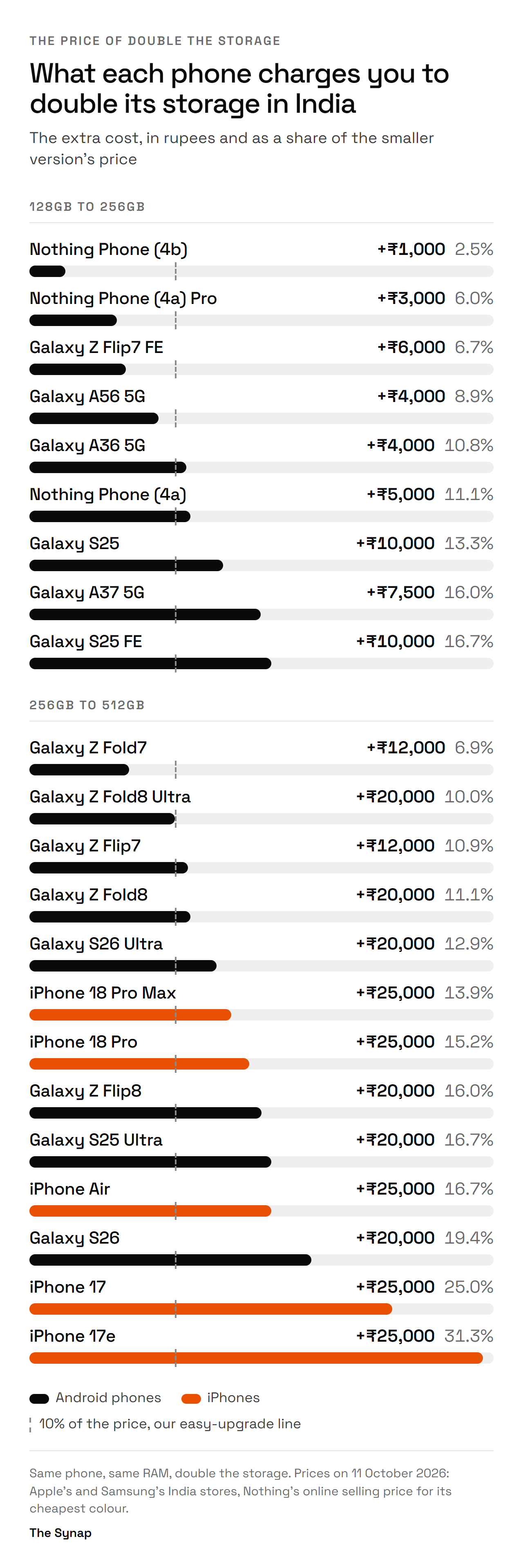
Is 256GB worth it over 128GB?
Yes, when the 256GB version costs 10% more than the 128GB or less. On the Nothing Phone (4b), Nothing Phone (4a) Pro, Galaxy Z Flip7 FE and Galaxy A56 5G it does, so take the bigger one. On the Galaxy S25, Galaxy A37 5G and Galaxy S25 FE the step is 13% or more, and 128GB plus a cloud plan is the smarter buy.
Why 10%? Storage is the spec that decides when a phone starts to feel old. A slower chip is something you notice now and then. A full phone nags you every day, with updates that won’t install and “storage almost full” warnings at the worst possible moment. Paying a tenth more up front to push that day back by a couple of years is a good deal. Paying a sixth more usually isn’t, because cloud storage does much of the same job for less.
What does 256GB cost over 128GB on each phone?
Between ₹1,000 and ₹10,000, on the nine phones that sell both. Nothing is the cheapest: ₹1,000 on the Phone (4b), ₹3,000 on the Phone (4a) Pro and ₹5,000 on the Phone (4a). Samsung asks ₹4,000 on the Galaxy A36 5G and Galaxy A56 5G, and ₹10,000 on the Galaxy S25 and Galaxy S25 FE.
| Phone | Extra for 256GB | Share of price | 128GB | 256GB |
|---|---|---|---|---|
| Nothing Phone (4b) | ₹1,000 | 2.5% | ₹39,999 | ₹40,999 |
| Nothing Phone (4a) Pro | ₹3,000 | 6.0% | ₹49,999 | ₹52,999 |
| Galaxy Z Flip7 FE | ₹6,000 | 6.7% | ₹89,999 | ₹95,999 |
| Galaxy A56 5G | ₹4,000 | 8.9% | ₹44,999 | ₹48,999 |
| Galaxy A36 5G | ₹4,000 | 10.8% | ₹36,999 | ₹40,999 |
| Nothing Phone (4a) | ₹5,000 | 11.1% | ₹44,999 | ₹49,999 |
| Galaxy S25 | ₹10,000 | 13.3% | ₹74,999 | ₹84,999 |
| Galaxy A37 5G | ₹7,500 | 16.0% | ₹46,999 | ₹54,499 |
| Galaxy S25 FE | ₹10,000 | 16.7% | ₹59,999 | ₹69,999 |
Which phones make 256GB an easy yes?
Four of them come in under the 10% line, and each has a small catch worth knowing.
- Nothing Phone (4b): +₹1,000. That’s 2.5% of the price, less than a decent case. The catch is the version below it. The 8GB + 128GB costs ₹39,999, a full ₹10,000 more than the 6GB + 128GB at ₹29,999. So either save ₹10,000 with the 6GB model, or pay ₹1,000 more and get 256GB. The one in the middle makes no sense.
- Nothing Phone (4a) Pro: +₹3,000. Watch the colour. On the day I checked, the 8GB + 256GB cost ₹52,999 in black and ₹57,999 in silver. If you aren’t fussy, black saves you ₹5,000.
- Galaxy Z Flip7 FE: +₹6,000. That’s 6.7% on a ₹89,999 foldable. If you’re already spending that much on a flip phone, don’t squeeze it on space.
- Galaxy A56 5G: +₹4,000. Its 256GB version costs ₹48,999, which is ₹5,500 less than the newer Galaxy A37 5G’s 256GB at ₹54,499. Our Galaxy A37 5G vs Galaxy A56 5G comparison has the rest of the differences.
Two more sit just over the line: the Galaxy A36 5G (+₹4,000, 10.8%) and the Nothing Phone (4a) (+₹5,000, 11.1%). Close enough to be worth it if you keep a phone for three years or more. On the Phone (4a), go one step further: the 12GB + 256GB costs ₹50,999, just ₹1,000 more than the 8GB + 256GB, for 4GB of extra RAM.
Where is 256GB poor value?
The Galaxy S25 and Galaxy S25 FE charge ₹10,000 for it, and the Galaxy A37 5G charges ₹7,500, or 16% of its price. On those three, buy the 128GB and put a cloud plan on top if you run short. You’ll come out ahead for years.
Further down the range, Samsung mostly doesn’t give you the choice. On Samsung’s India store, the Galaxy A07 5G, Galaxy A17 5G, Galaxy A27 5G, Galaxy M17 5G, Galaxy F17 5G and Galaxy M47 5G come with 128GB in every version, and the extra money buys RAM instead.
Why does Apple charge ₹25,000 for more storage?
Apple doesn’t say, but the pattern is plain: it charges a flat ₹25,000 to go from 256GB to 512GB on every iPhone it sells in India, from the ₹79,900 iPhone 17e to the ₹1,79,900 iPhone 18 Pro Max. Going from 512GB to 1TB costs ₹50,000 more, and from 1TB to 2TB another ₹75,000.
A flat fee hits the cheapest iPhones hardest. On the iPhone 18 Pro Max, ₹25,000 is 13.9% of the price. On the iPhone 17e it’s 31.3%, and that produces a genuinely silly result: the 512GB iPhone 17e costs ₹1,04,900, which is ₹5,000 more than a 256GB iPhone 17. The iPhone 17 also gets a bigger 6.3-inch 120Hz screen and a second 48MP camera. If 256GB isn’t enough for you, skip the 17e. Our iPhone 17 vs iPhone 17e comparison lays out everything else.
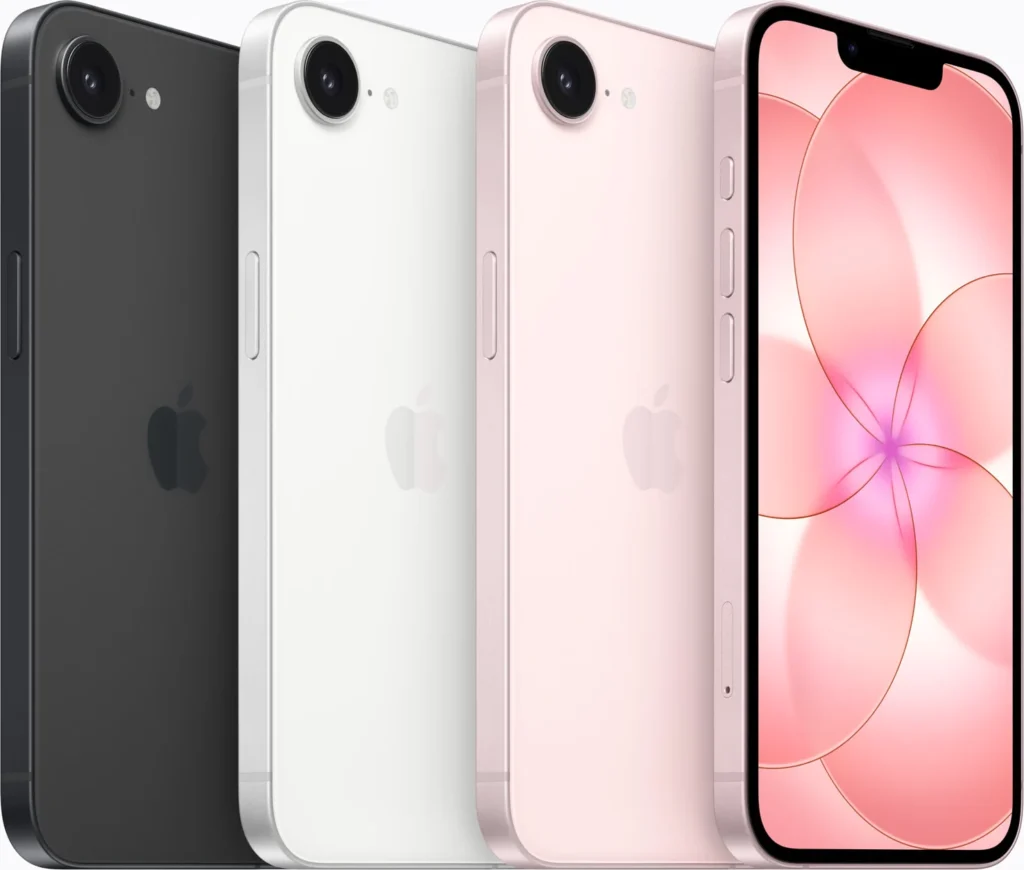
The good news: Apple now starts almost every iPhone at 256GB, so most iPhone buyers never need the step. The exception is the iPhone 16, which Apple still sells only as a 128GB model, for ₹89,900. The iPhone 17e costs ₹10,000 less with twice the storage and a newer A19 chip. The iPhone 16 does keep a second, ultrawide camera, which is its best argument.
| iPhone | 256GB | 512GB | 1TB | 2TB |
|---|---|---|---|---|
| iPhone 17e | ₹79,900 | ₹1,04,900 | Not offered | Not offered |
| iPhone 17 | ₹99,900 | ₹1,24,900 | Not offered | Not offered |
| iPhone Air | ₹1,49,900 | ₹1,74,900 | ₹2,24,900 | Not offered |
| iPhone 18 Pro | ₹1,64,900 | ₹1,89,900 | ₹2,39,900 | ₹3,14,900 |
| iPhone 18 Pro Max | ₹1,79,900 | ₹2,04,900 | ₹2,54,900 | ₹3,29,900 |
| iPhone Duo | ₹2,99,900 | ₹3,24,900 | ₹3,74,900 | ₹4,49,900 |
What does Samsung charge on its flagships and foldables?
₹20,000 to go from 256GB to 512GB on the Galaxy S26, Galaxy S26 Ultra, Galaxy S25 Ultra, Galaxy Z Fold8, Galaxy Z Fold8 Ultra and Galaxy Z Flip8. Last year’s Galaxy Z Fold7 and Galaxy Z Flip7 charge ₹12,000, which makes the Fold7’s 512GB the best storage deal at the top end, at 6.9% of the price.
The plain Galaxy S26 is where it stings: ₹20,000 on a ₹1,02,999 phone is 19.4%, the highest share of any phone in our list outside Apple. And the Galaxy S26+ and Galaxy S26 FE come in 256GB only, so there’s nothing to decide on those.
Is cloud storage cheaper than a bigger phone?
Usually, once the step passes ₹10,000. Google One’s 100GB plan costs ₹130 a month in India, and Apple’s 200GB iCloud+ plan costs ₹219 a month. The ₹25,000 Apple charges for 512GB pays for more than nine years of that iCloud plan, and the ₹20,000 on a Galaxy S26 covers more than 12 years of Google One.
| Phone | Extra for double the storage | Pays for this much cloud storage |
|---|---|---|
| Nothing Phone (4b) | ₹1,000 | 7 months |
| Galaxy A56 5G | ₹4,000 | 2 years, 6 months |
| Galaxy S25 FE | ₹10,000 | 6 years, 4 months |
| Galaxy S26 | ₹20,000 | 12 years, 9 months |
| iPhone 17e | ₹25,000 | 9 years, 6 months |
The cloud has real downsides. It’s a bill that never ends, you need a decent connection to get your things back, and it does nothing for the other things that fill a phone: apps, games and offline downloads all have to live on the phone itself. On the other hand, both of those plans can be shared with up to five family members, which tips the maths further.
My rule: under 10%, buy the storage. Over 15%, buy the smaller version and a cloud plan if you need one. In between, it comes down to how long you keep your phones.
How much storage do you actually need?
Check your current phone before you decide. Open Settings, then Storage, and see how much you’ve used and how long it took to get there. Then buy a version with at least double that, so the new phone has room for the same years again. If you’ve used less than about 60GB, 128GB will do.
- 128GB works if you mostly call, chat, pay with UPI and stream, and your photos back up to Google Photos or iCloud.
- 256GB is right for most people who keep a phone three years or more: years of photos on the phone, a couple of big games, and family WhatsApp groups that never stop sending videos.
- 512GB is for people who shoot a lot of 4K video or never delete anything. The iPhone’s camera settings estimate a minute of 4K video at 60 frames a second at around 400MB, so a 20-minute recording of a cousin’s sangeet comes to about 8GB.
For a lot of people in India, WhatsApp is the quiet storage hog. Before you pay for more space, open WhatsApp and go to Settings, then Storage and data, then Manage storage. It shows which chats are sitting on gigabytes of forwarded videos, and you can clear them in a minute.
Can you add a memory card instead?
Only on some phones. No iPhone has ever had a memory card slot, and neither do Samsung’s current Galaxy S phones or its foldables. Some budget Android phones still take a microSD card, so check the maker’s spec page before you count on one. A card is fine for photos, music and videos, but apps belong on the phone’s own storage.
Quick answers
Is 128GB enough in 2026?
For plenty of people, yes: if you stream instead of downloading, back your photos up to the cloud and replace your phone every two or three years. If your current phone has already used more than about 60GB, it isn’t.
Does the 256GB version have more RAM?
Sometimes, and it changes the maths. On the Galaxy A56 5G and Nothing Phone (4a) Pro, the first step up keeps the same 8GB of RAM. On the Nothing Phone (3), the 512GB version also adds 4GB of RAM, for ₹10,000 more. Check the full version name, such as “8GB + 256GB”, before you compare prices.
Where can I see every version’s price?
On each phone’s page on The Synap. The price section lists every version, cheapest first. Pick one and it tells you what the extra money buys over the cheaper version below it.